ccMonetproduct case

Code computes the facts. AI reasons over them.

ccMonet is an AI accounting platform for small businesses and their accountants. I designed it so models never become the source of truth for computed financial numbers: the platform calculates, the agent interprets and acts, and people retain accountability. Accountants close faster; owners get timely, accurate numbers.

100+paying SMB entities in Singapore, Hong Kong and Malaysia, with 98%+ logo retention
90%+of bookkeeping preparation automated when source documents are complete
<1 daymonth-end close for complete-document clients, down from 3–5 days
> 20252026 revenue through August already exceeds all of 2025

Anything missing or ambiguous goes to a person.

How I think about AI products

Four decisions in ccMonet

Financial software has a deterministic source of truth. AI sits above it to interpret ambiguity, agents act through constrained tools instead of bypassing the product, and people keep accountability where evidence is incomplete.

Document AI

Automate the preparation, not the accountability.

AI extracts and structures incoming financial documents, from invoices and receipts to bank statements and contact lists. Deterministic checks validate what can be validated. Strong evidence flows forward; incomplete or conflicting evidence becomes an exception for an accountant.

  • Schemas limit what the model may return; cross-document and math checks catch the rest.
  • A quality pipeline checks every output: real-invoice benchmarks, automated checks, failure tracing and post-processing.
  • Prompt and agent changes are A/B tested on real cases before every launch.
  • AI may only use accounts the business has switched on for AI Match.

Result: 99%+ field-level accuracy on our real-invoice benchmark; 90%+ of bookkeeping preparation automated when source documents are complete, and month-end close cut from 3–5 days to under 1 day.
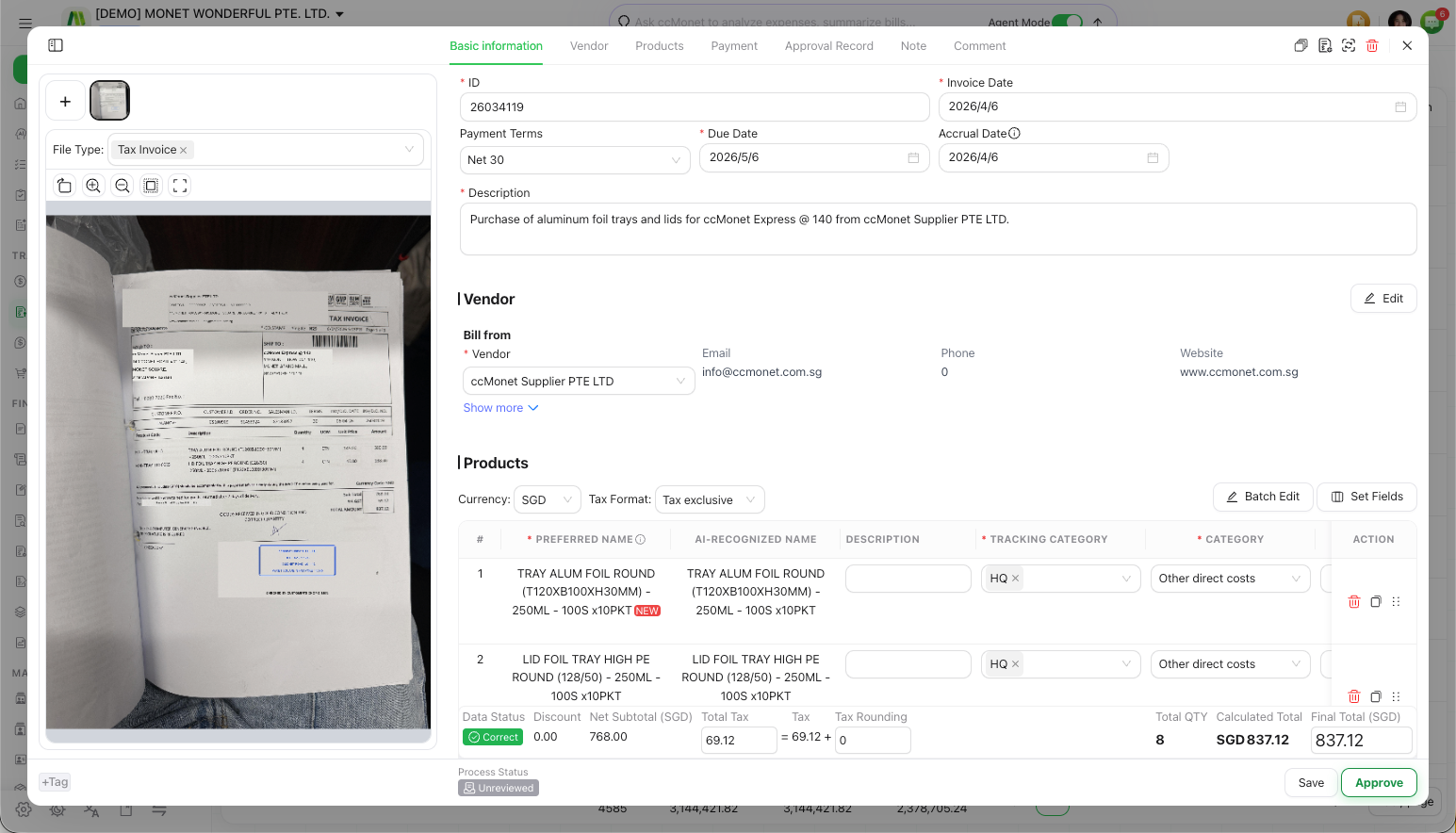
Screenshot from the ccMonet user guide: captured vendor bill with source preview, extracted fields and editable line items
User manual screenshot: Review and edit a captured vendor bill
Vendor bill review: source document alongside editable extracted fields. View user guide ↗

Bank reconciliation

A wrong match is worse than no match.

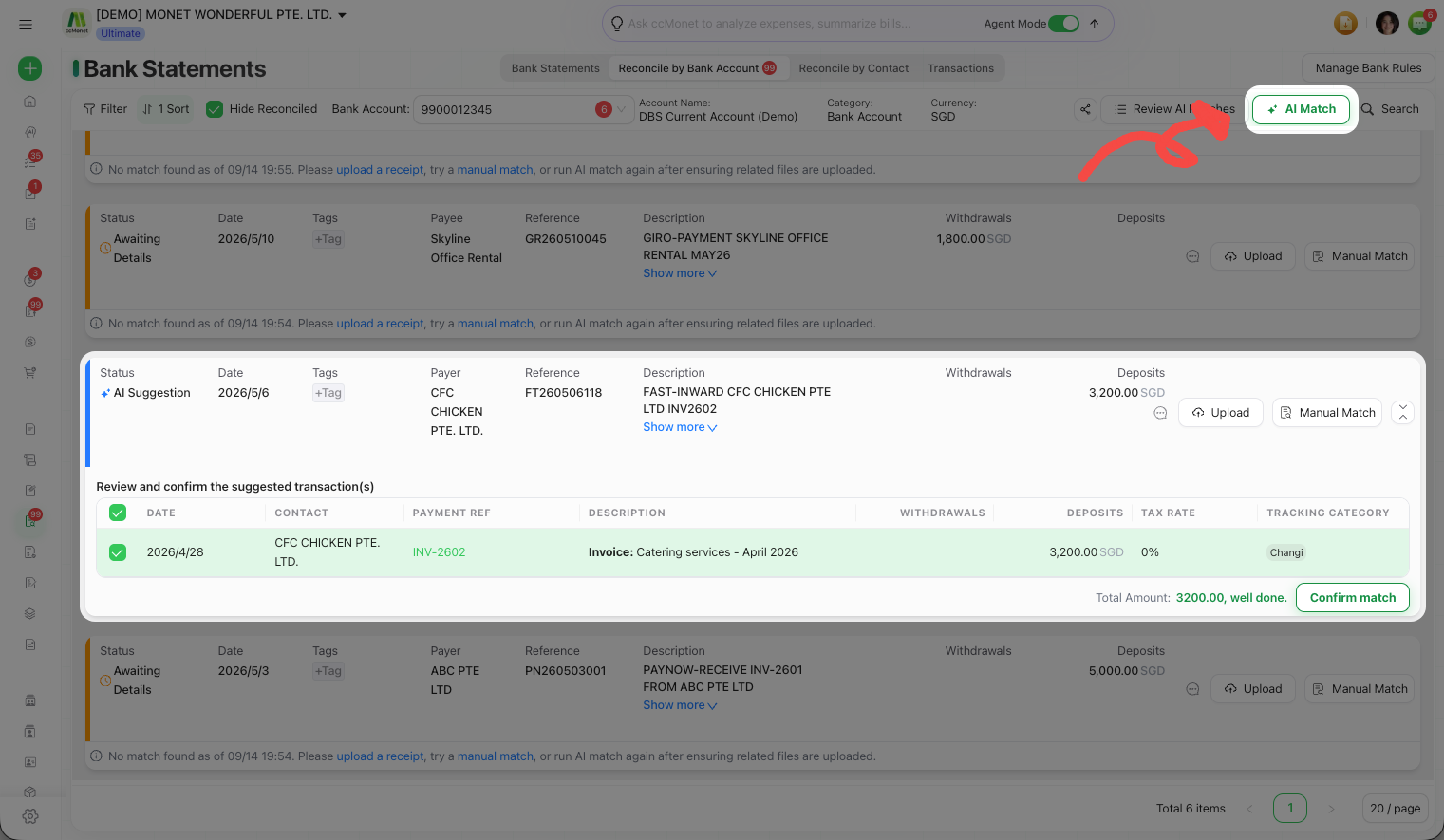
Rules and a matching algorithm narrow candidates first; AI and the agent resolve what's left from descriptions and documents. Weak evidence becomes an exception, not a guess.

  • Reference, counterparty and amount are explicit evidence.
  • Gaps are typed: FX difference, rounding, bank fee.
  • "No match" is a valid answer.

Result: ~80% of bank lines matched by AI when documents are complete; everything else is held for a person.

Reconciliation decisionsPrecision over recall
Bank evidence
System decision
FAST in, Harbour Noodle Co.3,000.00
Invoice INV-01423,000.00Reference and amount
Card, cloud software (USD)1,342.50
Bill, USD 1,000.00Matched with FX differenceCounterparty and amount
Card, merchant 2291388.00
No supporting documentHeld for reviewNot enough evidence
Screenshot from the ccMonet user guide: bank transaction AI Match suggestions with confirmation and rejection actions
User manual screenshot: Confirm or reject an AI Match
AI Match review: confirm the supported matches and reject the wrong ones. View user guide ↗

Agent design

Same system, narrower authority.

Monet reads the full ledger and source records, runs scheduled closing checks, and flags cash, margin and receivable risks with drill-down to the source transaction. Its write actions go through existing product APIs and validation, with an additional allowlisted tool, route and output policy.

  • Only declared tools and routes; no direct database writes.
  • Outputs trimmed to a schema; policy mismatches fail closed.
  • Identity comes from the session, never from model input.

Result: owners get timely management numbers, and routine financial review dropped from hours to under 30 minutes.

Agent control planeTools, then policy, then existing APIs
Monet or an external agentIntent, reasoning, plan
Declared tools and policyInput schema, route and output allowlists
ccMonet APIsPermissions, validation, approvals, audit
Read: all financial dataBuilt in: schedules, closing checksWrite: limited, reviewed

Financial controls

A new kind of operator needs new controls.

Traditional accounting software trusts the authenticated user as the operator. AI needs narrower authority, stronger provenance and reversible actions, so AI drafts are kept apart from the posted books.

  • Approval state decides when a record becomes authoritative.
  • Unmatch and reversal are first-class actions.
  • Exceptions come with a next step, not a model error.

Result: AI-originated changes stay traceable to their source evidence, actor and approval or reconciliation path, so accountants review instead of redo.

AI draft
  • Extracted fields
  • Suggested accounts and matches
  • Agent-prepared entries
Posted books
  • Ledger entries and balances
  • Reconciled bank lines
  • Reports and tax figures
Between them: validation, approval and a recorded actor. Nothing crosses on model confidence alone.

My role

As one of two PMs, I own the product boundary between probabilistic AI and deterministic financial systems. I lead product decisions across document intelligence, reconciliation, agent permissions, accounting workflows and AI evaluation, with a cross-functional team of engineers and accounting specialists, including CPAs.

Product architectureSet the line between code, agent and person, and the agent's read and write scope.
AI evaluationBuilt the end-to-end AI quality pipeline: real-invoice benchmarks, automated checks, failure tracing (Langfuse) and A/B tests before every launch.
Accounting workflowsOwned requirements for the ledger, AP/AR, banking, payroll, fixed assets, IFRS 16, multi-currency, quotations and POs, permissions and reports.
GTM and pricingTook ccMonet to 100+ paying entities across three markets with 98%+ retention, with agent features and POS reconciliation as key growth drivers; shaped transaction-volume pricing.

Don't start from what else we could build. Start from who will pay for which result, what data and capability that result needs, and whether we can deliver it reliably and repeat it with what we have.

Take the ideas further.

Explore the thinking behind this work, or use the same decision framework on your own product.

Open-source Skill

Use my product decision framework.

Review features, design AI-native workflows, and challenge product direction using my practical design principles.

Get the Design Skill
Coming soon

Ask about my work in your AI assistant.

Connect ChatGPT or Claude to a read-only portfolio MCP and explore my experience, ccMonet, and product decisions.

The Skill is available on GitHub. The portfolio MCP is a preview; no live server is connected yet.

Connect my portfolio MCP

Explore my experience and product decisions with your own AI assistant. One public, read-only connection—no access to private company systems.

Connection coming soon

Claude · Customize → Connectors

Add a custom connector, then paste the remote MCP URL below. Claude supports remote MCP connectors; your workspace may require admin permission.

MCP URL available when launched

This is a connection preview, not a working MCP integration. Account and workspace permissions may affect custom connector availability.